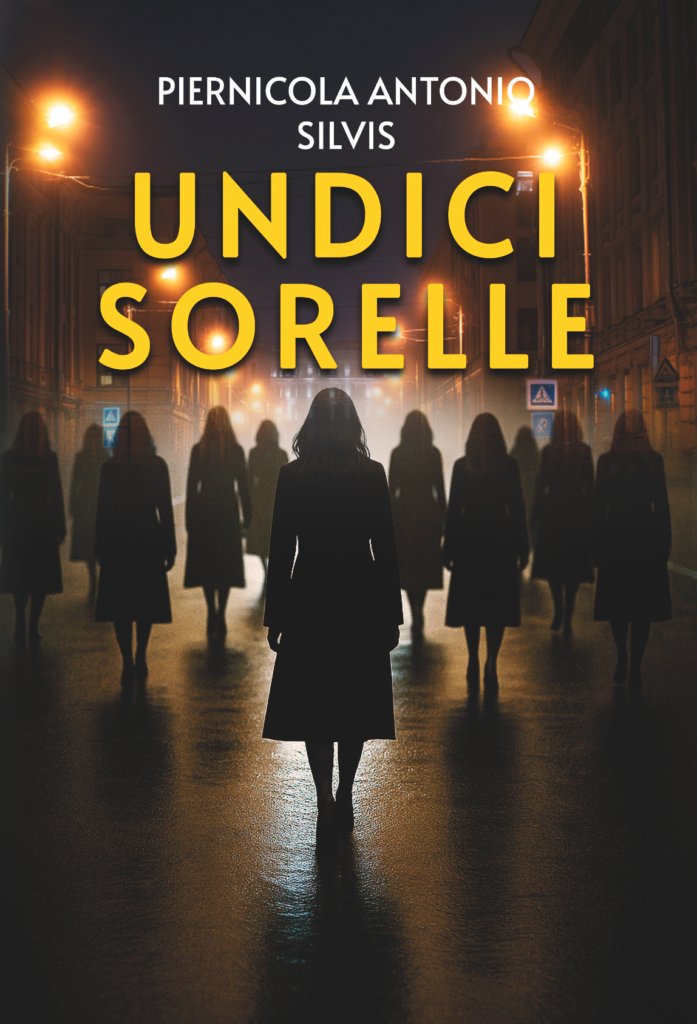


A girl disappears on Christmas night, leaving behind a void that time cannot fill. Amid suspended memories, shattered illusions, and a changing Italy, a young police officer pursues the disturbing shadow of a murderer for over a decade, turning the investigation into a showdown.
Rimini, Christmas 1988. After Midnight Mass, Giacomo and Giuliana Santarcangelo They return home to celebrate with their daughters, but Sofia, the youngest, fifteen, doesn't return from a pre-Christmas party. She will never be heard from again. The missing person report is filed by Caterina Barone, a young Sicilian police officer newly arrived at the Rimini police station. The investigation stalls, until, a year and a half later, an entire family is massacred. Instinctively, Caterina connects the massacre to Sofia's disappearance. In January 1991, another woman is killed: it is now clear that a serial killer is moving in the shadows, choosing only female victims. He sends delirious and cultured messages to newspapers, signing himself "“The Son of the After Time”.
We asked some questions to Piernicola Silvis.
The novel opens with a disappearance on a symbolic Christmas night. Why did you choose this moment to begin the story? Christmas Day has powerful symbolism that all of us, in one way or another, have carried with us since birth. Furthermore, the disappearance occurred on Christmas Eve thirty-eight years ago, a long period of time that amplifies the mystery. A disappearance on such a religiously charged day creates a strong contrast, and in a novel, especially a thriller, contrasts are crucial. But beyond that, I enjoyed describing the Christmas atmosphere of Rimini almost forty years ago.
Rimini is more than a backdrop: it almost becomes a character. What role did the city play in building narrative tension? The wintry Rimini of days gone by is more than a setting; it's a character in the novel. This city evokes ancient memories and evocations. Fellini, the times I went there on holiday with my family as a child, the international atmosphere, the dance halls... Fred Bongusto... Then again, I adore the winter sea, and describing Rimini in January, with its empty, cold beaches, was almost like a self-therapy session. Ultimately, the entire novel is permeated by a thread that harks back to the passing of time and echoes of a youth long gone.
“The Child of After Time” — it evokes something philosophical and disturbing. How did this name come about? Even though they are almost always capable of understanding and willing, the real
Serial killers are people severely disturbed by sadistic-compulsive psychopathologies. They're generally on the fringes of society, but there are also individuals affected by more hidden psychopathies, which allow them to fit into everyday life, and I wanted my killer to fit into this category. The name I gave him indeed evokes a sinister fascination, and it came to me spontaneously while writing, without any research. Often, and I don't think I'm the only one, creative inventions strike when you least expect them.
The book spans twelve years of Italian history. How important was it to weave the thriller into the political and social context of the time?
The fear of the inexorable passage of time is humankind's worst obsession, even if we often don't realize it. In my opinion, the period from 1988 to 2000 is one of the most significant of the postwar period. At the end of the 1980s, we leave behind the Years of Lead and begin to contemplate the illusion of replacing an old and corrupt political system with a modern and vibrant one. The year 2000, then, arrives with a deeply rooted Second Republic, but in the meantime, the illusions of the past have foundered, and the Cosa Nostra and Uno Bianca massacres have bloodily marked the decade. It's a disturbing and iconic period, perfect for the novel's long investigation, but it wasn't easy to pull it off. The risk was to include too many events in too much detail, but doing so would have slowed down the thriller nature of the story. Therefore, I had to select the events and include them only in quick blurbs. The reader had to perceive the passing of the years, but not have the impression that this was merely a narrative gimmick. The narration had to flow smoothly and naturally. I hope I've succeeded.
Caterina Barone is a complex protagonist, marked by the past but determined. What did you want to convey through her about the role of women in law enforcement in the 1990s?
Caterina's career path was similar to mine, so in the novel she follows the same path. In 1981, she was indeed the first woman admitted to the competitive exam for State Police Commissioner (her colleague in the course had a completely different name, but she too was Sicilian). Caterina's character challenges some stereotypes and prejudices that, indeed, circulated somewhat about female police officers in the early 1980s, but which have since crumbled completely. I don't recall ever hearing a single word in a police station about a supposed incompetence in investigations because a colleague was a "woman." On the contrary, women are often the best investigators.
The relationship between professional investigation and emotional involvement is central to the novel. How difficult was it to maintain this balance?
In writing this story, it was difficult to blend Caterina's passion for hunting the killer with her professional cool. She is also driven by feelings of revenge for the massacre of women, which she watched almost helplessly for ten years, but she must repress them because she is a civil servant and cannot allow passion to overwhelm her profession, even though at times she feels it would be better to give in to this impulse.
To manage these passages, I alternated scenes in which Caterina experiences feelings of human indignation with others in which professionalism takes over.
What was the most difficult scene to write — emotionally or technically?
Yes, there is one. It takes place in an abandoned cemetery in the province of Rimini, in front of Montebello Castle (the manor where Azzurrina's ghost is said to still haunt today). It's a scene that deeply touched me on an emotional level, and to wrap it up, I obsessively studied every comma and every word. Obviously, I can't say more to avoid spoilers. A tip: anyone who wants to know more about Caterina can read a long excerpt from the novel's opening seven chapters on the book's Amazon page.